Assessing Leadership Readiness for Executive Roles with the
Authentic Program
Evaluate the foundational qualities essential for executive selection.
In corporate management, one of the most critical questions is who to entrust with leadership. Amid growing uncertainty in society and markets, sustaining enterprise value requires more than addressing immediate challenges, it demands identifying, developing, and selecting future leaders who can steer the organization forward.
When choosing executives, past results and career history alone are insufficient. What truly matters is how candidates think and decide, what values they hold, and what sense of responsibility underlies their actions. Such qualities can only be revealed through a deeper understanding of their reasoning, behavior, and mindset, not by conventional HR evaluations or surface impressions.
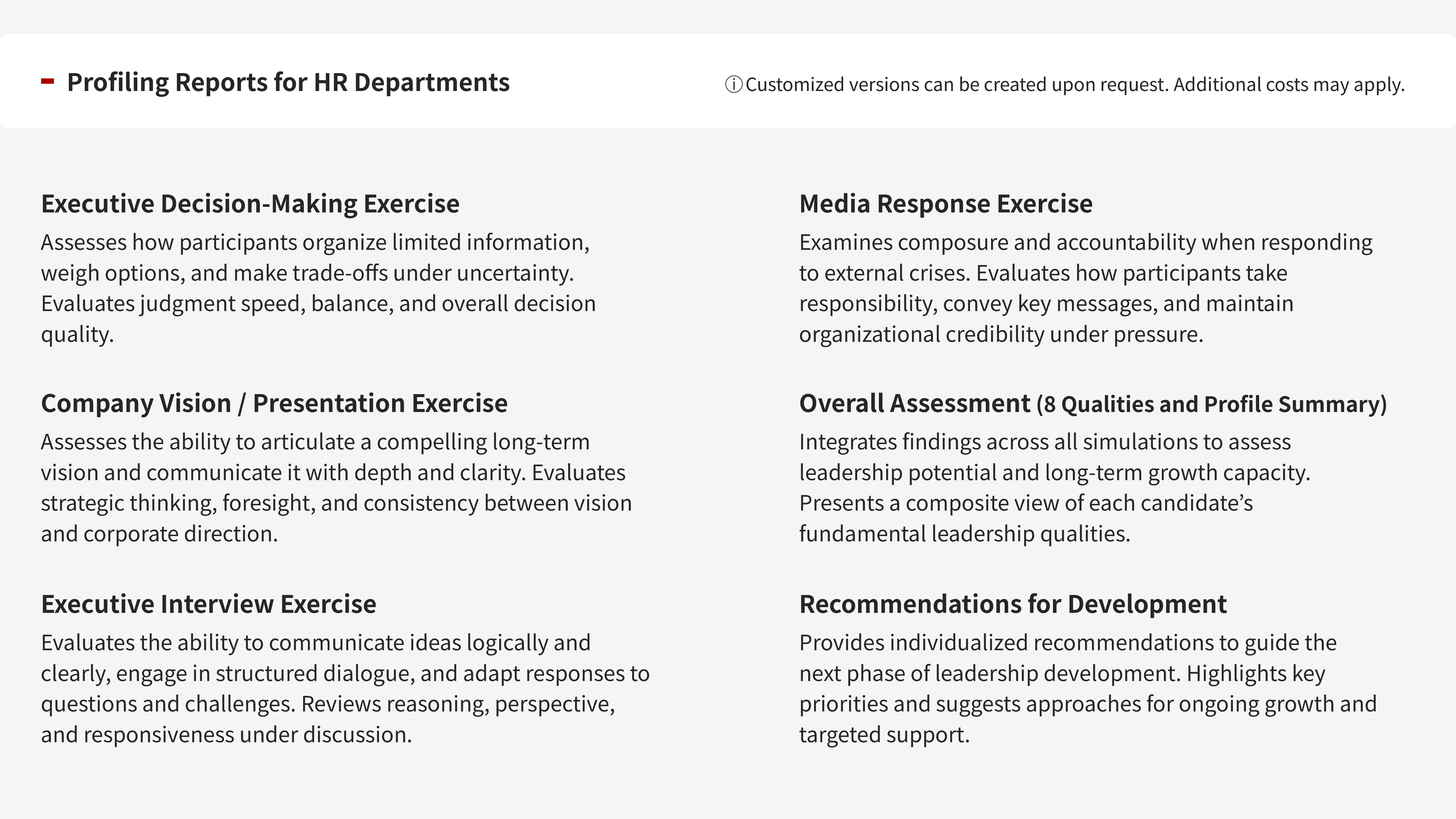
Authentic specializes in profiling executive candidates through business simulations that recreate critical decision-making environments. It visualizes each candidate’s underlying strengths, risks, and leadership readiness across eight qualities.
What we value most is not simply evaluating candidates but enabling sound judgment in selecting those truly fit to lead. With its precision profiling and data-driven insights, Authentic provides a reliable foundation for executive selection and succession decisions.
Assessing Core Attributes and Underlying Leadership Qualities
The requirements expected of executives and senior leaders are wide-ranging. Even a single management decision can have a decisive impact on an organization’s growth and sustainability, making it essential to evaluate leadership qualities and readiness objectively. At the same time, defining what kind of talent should lead the organization sends a strong message to internal and external stakeholders. It is therefore critical to clearly articulate the expectations for executive talent from multiple perspectives, including those from current management external observers.
The Tokyo Stock Exchange Corporate Governance Code (Source: Japan’s Corporate Governance Code 2021 Revision, Tokyo Stock Exchange, Inc.) specifies that CEOs should be individuals who possess the necessary qualities for leadership. In addition to industry and organization-specific attributes, executives must demonstrate the fundamental leadership qualities common to senior leaders across organizations. At Lead Create, we define the qualities required of executives as:
The foundation that enables leaders to take on management responsibility, enduring qualities that emerge, evolve, and mature through experience, reflection, and personal growth.
Unlike knowledge or skills that can be gained through training, these qualities are not immediately observable. While they may occasionally appear through behavior, they are grounded in the values, beliefs, and aspirations that shape judgment and action.
Building this definition, the Authentic Program assesses executive talent across the following dimensions.
| Layer | Quality | Definition | |
| Layer 1 | ─Influence─ Presence that unites people around a shared purpose |
Presence | Leverages individuality and authenticity to inspire others. |
| People Insight | Identifies potential and capability to position and develop talent effectively. | ||
| Layer 2 | ─Insight─ Awareness that enables clarity, foresight, and sound judgment. |
Vision | Anticipates change and defines a clear course for long-term growth. |
| Business Acumen | Makes balanced decisions that integrate strategic, organizational, and financial perspectives. | ||
| Layer 3 | ─Drive─ Motivation and resolve to sustain action. |
Aspiration | Pursues goals with resilience and determination. |
| Decisiveness | Makes decisions and acts with conviction under uncertainty or pressure. | ||
| Layer 4 | ─Inner Core─ Character and conviction that form the basis of leadership. |
Composure | Maintains perspective, making fair and objective judgments free from personal bias. |
| Integrity | Acts with sincerity and consistency, guided by ethics and values. |
Critical Decision-Making Challenges that Reveal the Caliber of Executives
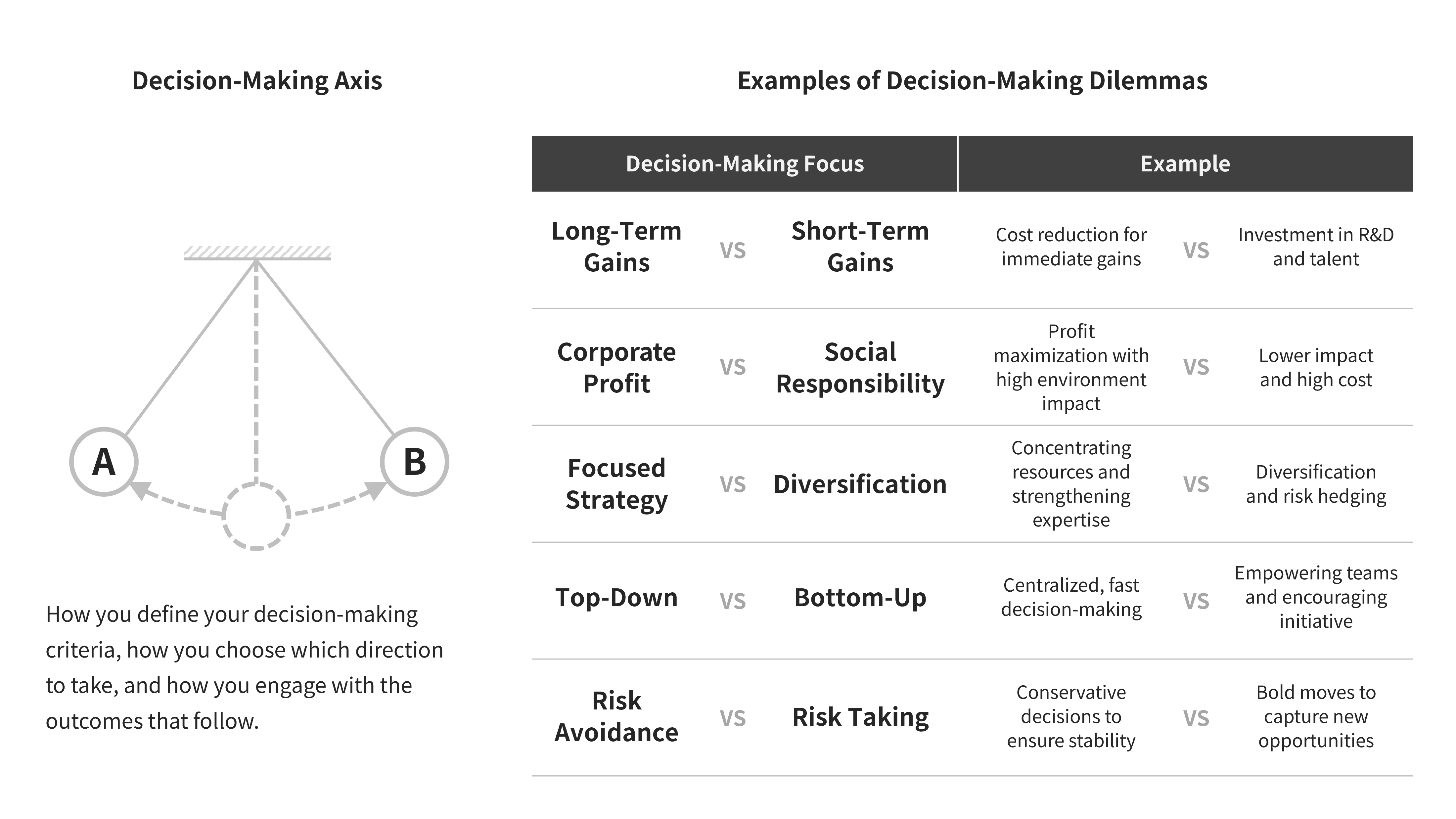
Executive decision-making rarely has a single right answer. What matters is the ability to make clear, deliberate choices while taking ownership of the trade-offs and implications. In Authentic, these situations are simulated to assess how executives define their judgment and conviction when facing competing priorities.
Overview of the Consulting Process
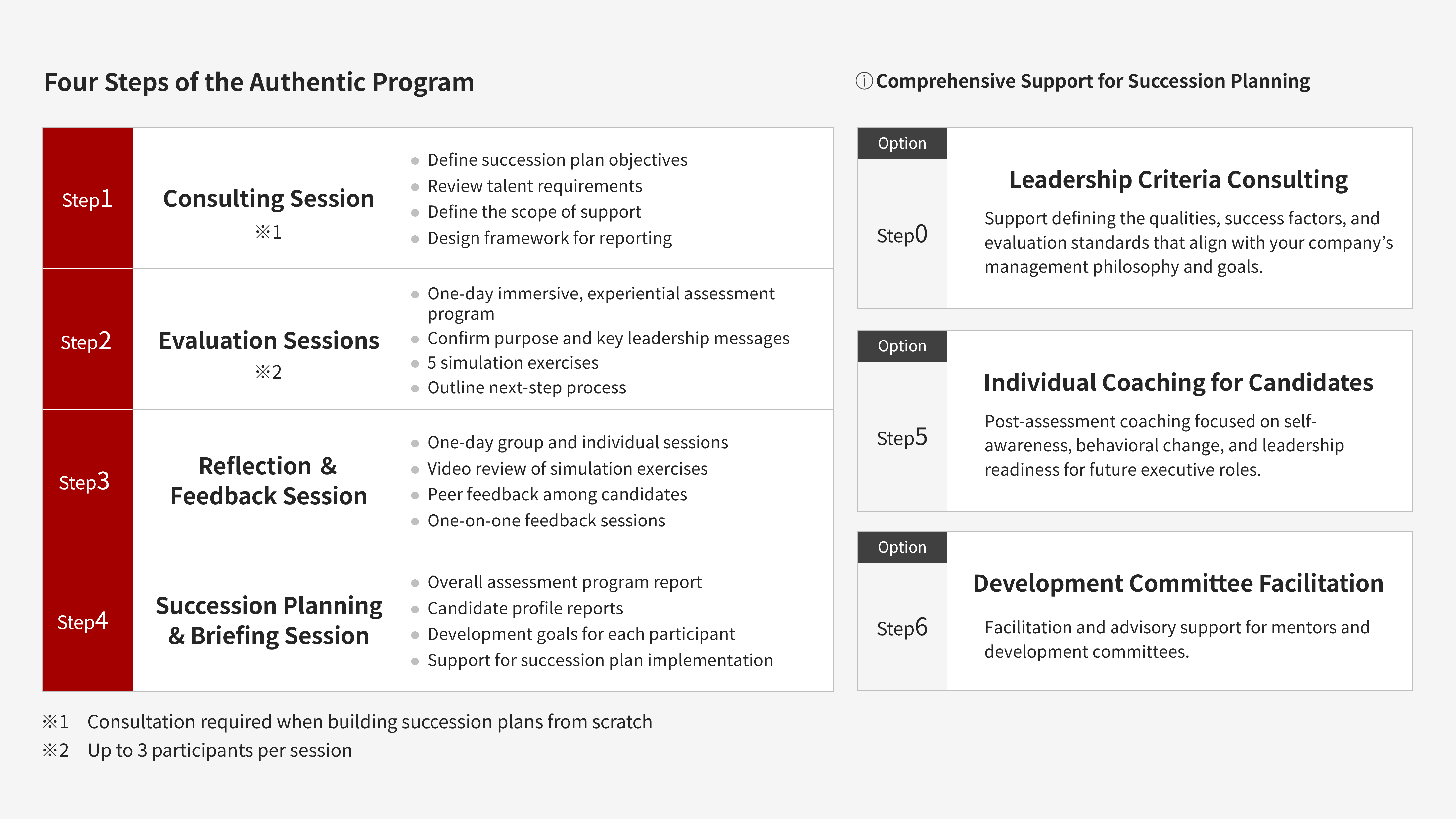
The Authentic Program provides end-to-end support for succession planning, from defining key policies and governance frameworks to clarifying current challenges and translating insights into action. By defining leadership requirements as the starting point and aligning internal and external assessments, the process helps build a more effective and actionable framework.
Four Steps of the Authentic Program
Step 1. Consulting Session
The consulting process begins with a review of your current succession plan challenges and proceeds through the following steps to build shared understanding and clarity.
| Step | Overview |
| Pre-Consultation |
|
|---|---|
| Leadership Requirements |
|
| Project Design |
|
| Deliverables |
|
| Follow-Up Planning |
|
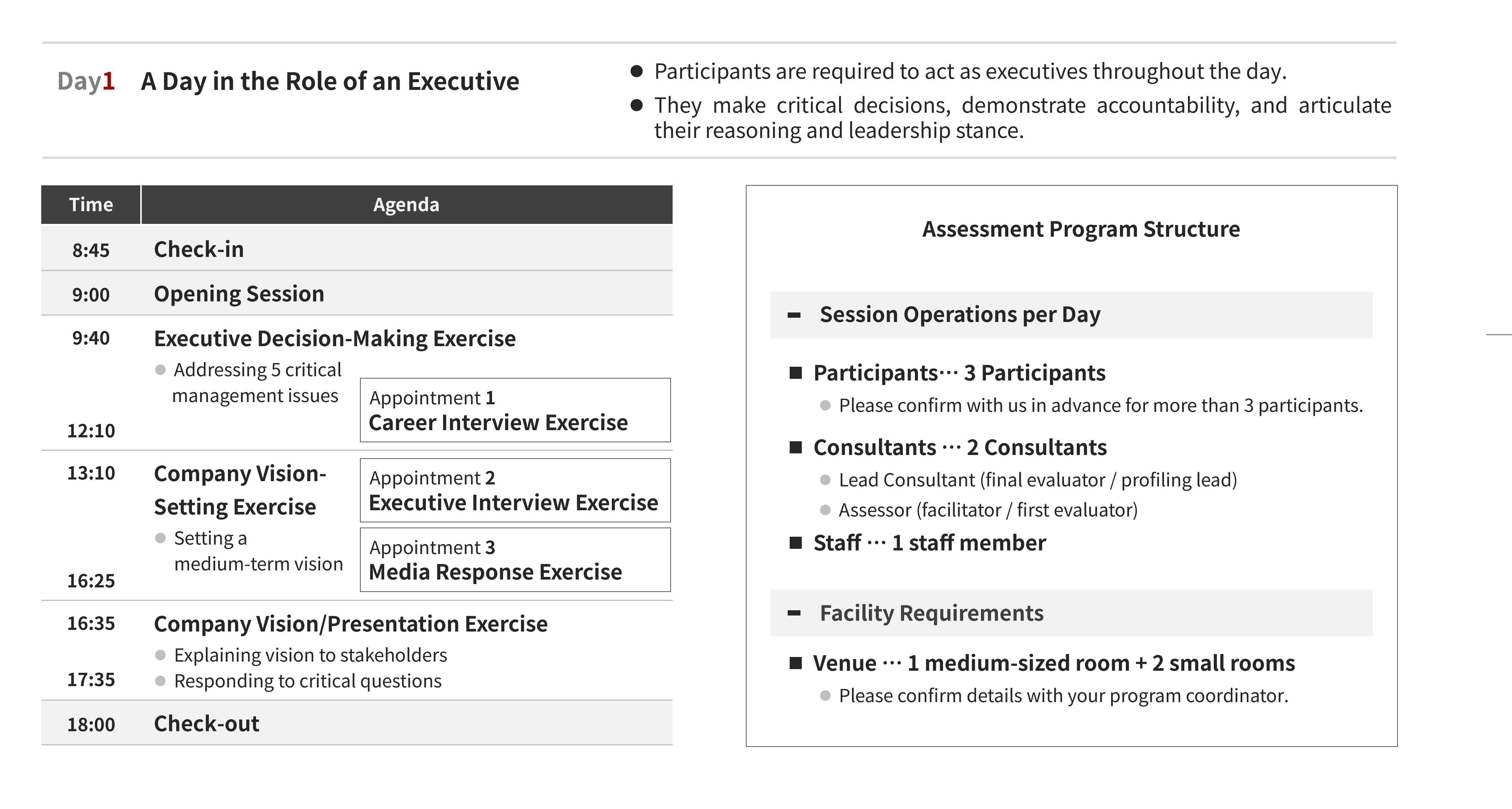
Step 2. Evaluation Sessions (Executive Simulation Exercises)
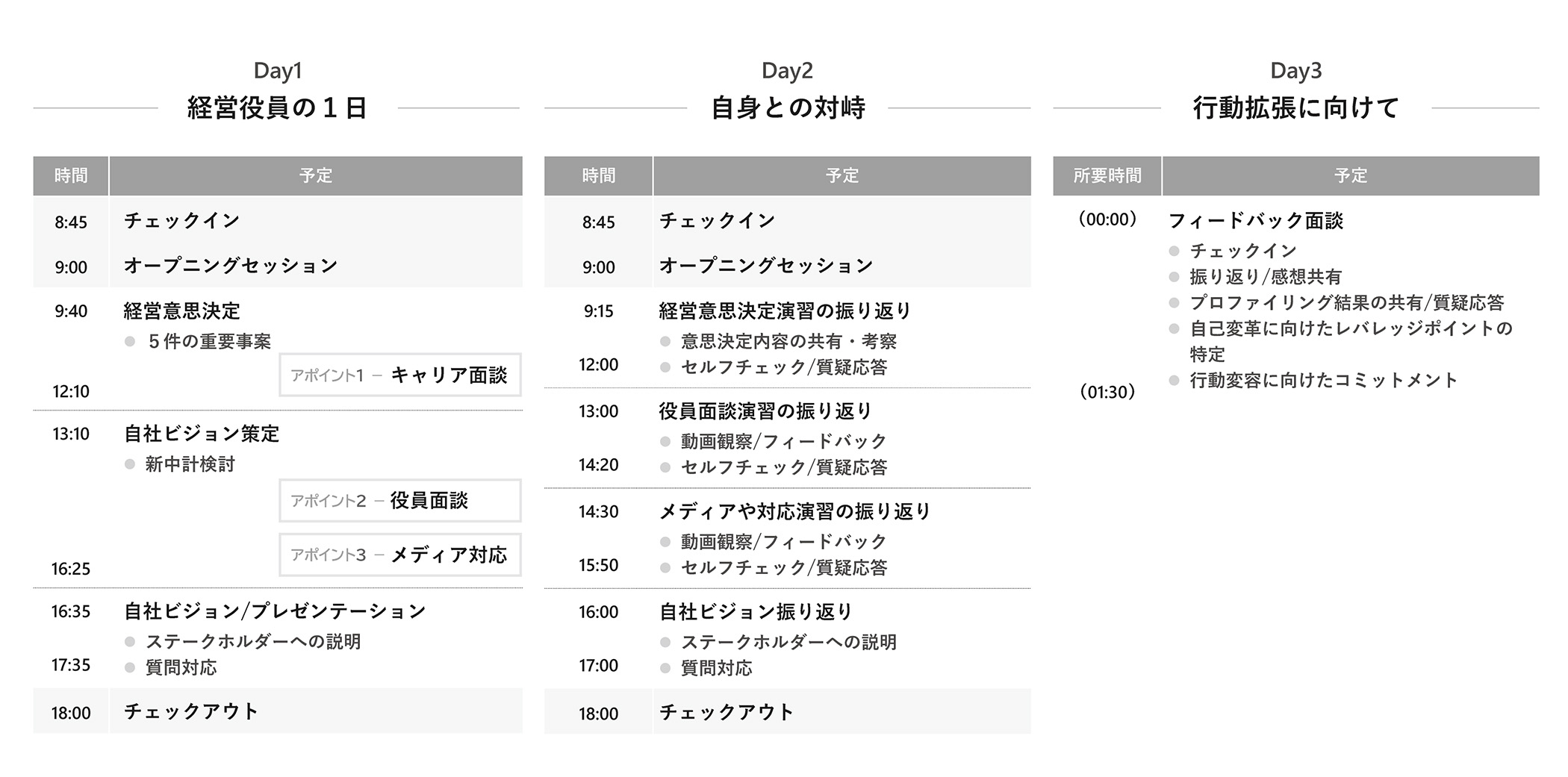
Participants are required to act as executives throughout the day. They make critical decisions, demonstrate accountability, and articulate their reasoning and leadership stance.
Step 3. Reflection and Feedback Sessions
By revisiting the executive simulations from Step 2, candidates gain deeper awareness of the expectations placed on executives, recognize gaps between those expectations and their current state, and clarify key areas for development.

Step 4. Succession Planning and Briefing Session
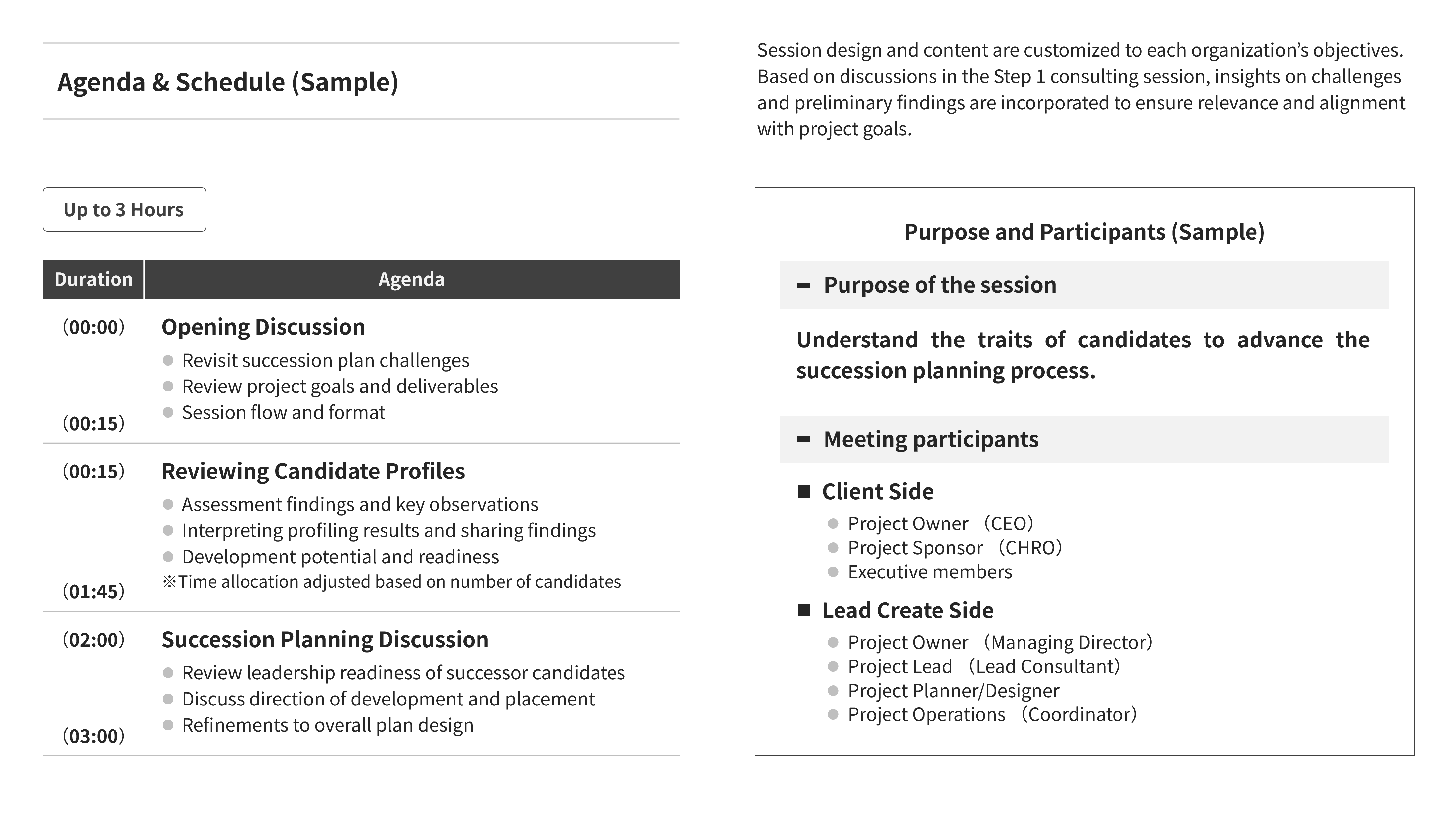
The Succession Planning and Briefing Session focuses on individual successor candidates, integrating profiling results to support critical succession planning decisions. The session facilitates multi-perspective discussions on each candidate’s growth potential, readiness for promotion, and positioning within the overall succession plan.
Insights Compiled into the Profiling Report
Frequently Asked Questions
-
Q.
What are the key points of operating a succession plan effectively?
-
A.The first step is to define its purpose and scope. Terms like succession plan or developing future executives can mean different things depending on the organization; who the plan applies to, how far ahead it extends, and who is responsible for developing successors. Each company should start by articulating its own definition and scope of the succession plan.
-
Q.
What are some tips for defining criteria for executive talent?
-
A.
Begin by clarifying the roles and responsibilities that the position is expected to fulfill.
Next, it is important to distinguish between the individual attributes specific to the position and the common attributes shared across executives at a similar level. Individual attributes are the expertise and experience necessary to achieve results in that particular role, and common attributes are the knowledge (such as business or financial literacy) and capabilities (such as conceptual thinking or leadership) expected of all executives regardless of specific position.
-
Q.
How does evaluating executive talent differ from assessing managers or department heads?
-
A.
Both executives and managers share the same fundamental responsibility of driving organizational results, and many of the required capabilities also overlap. As the organizational level rises, the scope of responsibility expands significantly, the number of stakeholders increases, and the complexity and difficulty of decision-making grow. This makes it important to look for attributes that extend beyond skills and capabilities. Broad knowledge and integrity, personal character and presence, and a deep sense of commitment and accountability to the organization are key attributes to assess.
-
Q.
What assessment methods are most effective for evaluating executive talent?
-
A.
The attributes required of executives are wide-ranging, and the optimal approach varies depending on whether the goal is to support a nomination committee’s final decisions or to identify candidates for a succession plan. Clarifying the purpose and timing of the assessment before considering the method is essential.
The Authentic Program is designed specifically to evaluate the qualities required of executives by incorporating assessment centers into executive simulation exercises, serving as profiling data to determine whether candidates possess the qualities needed to take on executive responsibilities, rather than for skill development.
-
Q.
Is there an open enrollment course for the Authentic Program?
-
A.There are currently no plans to offer an open enrollment course.
-
Q.
How many candidates can take part in the Authentic Program at one time?
-
A.
The program is available for one to three participants per session. For groups of four or more, additional sessions can be scheduled. Please contact us for more information.
-
Q.
Can the Authentic Program be conducted online?
-
A.
The program is conducted in person. Authentic is designed to assess the qualities required of executive leaders and places importance on observing behavior in face-to-face settings.
-
Q.
Is the Authentic Program offered in multiple languages?
-
A.
The program is offered in Japanese and English. Please contact us for more information.
Goals of the Trial Course
Identifying candidates who can be appointed to executive roles or nominated for succession plans is a critical management challenge. While many organizations recognize the need for objective assessments by external experts, determining which concept, evaluation framework, and criteria best fit their organization can be difficult.
At Lead Create, we believe that true understanding comes through experience. The trial course offers organizations the opportunity to experience and validate the Authentic Program before implementation.
Objectives of the Authentic Program
- Objectively evaluate and measure the readiness and potential of executive talent.
- Support executive appointment decisions and nominations for succession plans.
- Identify individual development goals and apply insights to future development initiatives.
Trial Course Overview
Download the Authentic Program Brochure
Contents
Scope of Support
- Overview and Scope of Succession Planning Framework
- Assessing Core Attributes of Executive Talent
- Foundational Qualities of Executive Talent
[Authentic] Executive Profiling Assessment Program
- Our Approach
- Eight Qualities Required of Executives
- Critical Decision-Making Challenges
- Overview of Simulation Exercises
- Overview of the Consulting Process
- Project Structure (Sample)
- Step 1 - Consulting Session
- Step 2 - Evaluation Sessions (Executive Simulation Exercises)
- Step 3 - Reflection and Feedback Sessions
- Step 4 - Succession Planning and Briefing Session
- Profiling Report
- Company Overview