
Managing Succession Planning
Strengthening Decision-Making in Succession Planning
When Succession Planning Does Not Function Properly
Many organizations have succession planning processes in place, but those processes do not always lead to action. The difficulty begins when stakeholders are not aligned on what the process is meant to achieve or who is responsible for moving decisions forward. In that state, candidate selection can remain unresolved, development can stay disconnected from day-to-day management, and key decisions can continue to be deferred. Without shared objectives and responsibility, succession planning becomes difficult to translate into consistent action and outcomes.
Key
Issues
- Goals are unclear, creating misalignment between leadership and HR
- Ownership is unclear, leaving involvement indirect
- Candidate selection lacks a shared standard
- Talent pools become static lists
- Successor planning is disconnected from placement and development
- Unclear responsibility delays selection and development decisions
- Senior leaders lack criteria for identifying and developing successors
Succession Planning Essentials
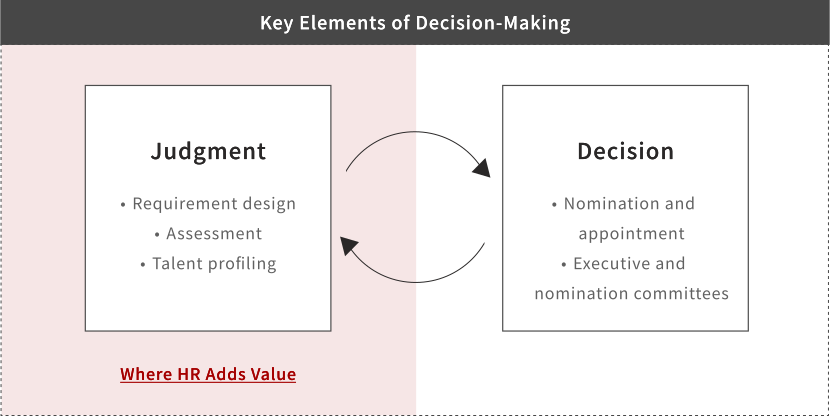
At its core, succession planning is about selecting and developing the leaders who will take on future executive roles. The difficulty is that these decisions involve uncertainty, since organizations are choosing people who will one day make decisions in conditions that cannot be fully predicted. A well-built system is important, but it only works when decision-making inside that system is clear. Succession planning depends on clarifying who decides, how decisions are made, and how selection and development can continue moving forward.
What is succession planning?
and entrusting future leaders
What is required?
Where does it break down?
Where does it start?
Risks in Succession Decisions
Succession decisions often stall for reasons that go beyond systems or information. Internal dynamics can affect how candidates are discussed and whether anyone takes clear responsibility for moving decisions forward. Because these influences are often difficult to see from within the organization, they need to be made visible and addressed through deliberate design and support.
Decision-Making Risks and Our Support
| Risks | Common Issues | Patterns | Our Support |
| Evaluation and Information Risk Biased or incomplete judgement |
|
|
|
| Organizational and Responsibility Risk Unclear ownership and accountability |
|
|
|
| Psychological and Emotional Risk Avoidance and low-quality decisions |
|
|
|
| Power and Political Risk Influence and bias distort decisions |
|
|
|
Identifying Executive Candidates
Combining both internal and external evaluation
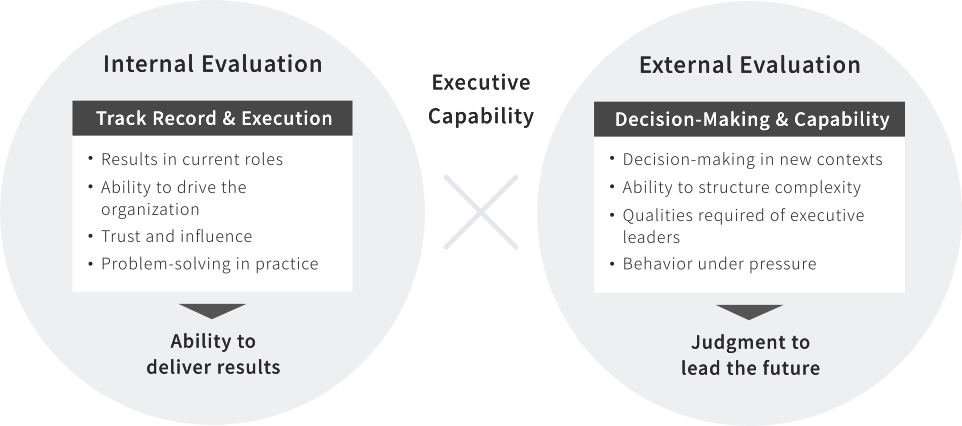
Improving succession decisions starts with how executive candidates are evaluated. Past performance and internal evaluation show how candidates have delivered results within the organization, but succession planning also needs to look at how they may think and act in unfamiliar situations. By combining internal evaluation with external perspectives, organizations can better understand both demonstrated performance and future leadership potential.
Objective decision-making
through external evaluation
External evaluation plays an important role in succession decisions because internal dynamics can make objective discussion difficult. When decisions rely only on internal evaluation, several patterns can influence the outcome:
- Preferences of influential business units or senior leaders take priority
- Long-standing practices or past precedents become the default criteria
- Decisions are shaped to maintain internal balance
In these situations, even strong candidates may not be evaluated through an objective process. As an external partner, Lead Create supports decision-making by bringing forward issues that are difficult to address internally and helping organizations move ahead with decisions they might otherwise avoid.
Developing Executive Candidates
Placement, not training, develops executive leaders
Developing executive candidates requires more than skill building or training. Future executive leaders need to move beyond the perspective of managing a business unit and learn to make decisions for the organization as a whole. This shift comes through placement in roles where candidates are close to management decisions, responsible for broader outcomes, and exposed to the impact of their decisions across the organization. Through these experiences, candidates begin to develop the perspective needed to lead at the executive level.
Development Starts with
Experience Design
Succession planning is not about adding more training programs, but about designing the right experiences for each candidate. These experiences may include:
- Placement in roles that span multiple business areas
- Participation in projects tied to critical business challenges
- Involvement in organization-wide decisions and resource allocation
- Roles that carry responsibility for both results and risk
Through these experiences, candidates begin to shift from a business unit mindset to an enterprise-level view.
Placement Decisions Matter the Most
Placement design is one of the most important decisions in succession planning:
- Who is placed in which role
- When candidates are given executive responsibility
- How much responsibility they are given
These are strategic decisions that shape how future leaders grow. The right placement can accelerate development, while the wrong placement can limit growth opportunities and weaken the effectiveness of succession planning.
Frequently Asked Questions
-
Q.
Why does selection stall even when a succession plan is in place?
-
A.
The issue is often unclear decision-making, not the system. A succession plan needs clear ownership, defined criteria, and a point where decisions are actually made. Without these, candidate selection can remain unresolved even when the process appears to be in place.
-
Q.
How should selection be handled when internal dynamics affect decisions?
-
A.
Succession planning is a company-wide decision about the organization’s future. Internal balance and business unit dynamics can influence decisions, so objective evaluation and structured discussion help keep the process transparent.
-
Q.
How should risky placement decisions be made?
-
A.
Placement is a strategic decision for developing future leaders, not simply a personnel transfer. The right experience can accelerate growth, while limited challenge can limit development. Placement scenarios should be designed around each candidate’s strengths and development areas while managing risk.
-
Q.
Should employees know they are in the talent pool?
-
A.
What matters is how expectations and growth opportunities are communicated. Simply telling employees they are candidates can create unnecessary pressure or competition. Sharing the purpose of future experience opportunities can support more self-directed growth.
-
Q.
Why is it difficult to update the talent pool?
-
A.
The issue is often the difficulty of changing past decisions, not evaluation. Updating the talent pool can affect existing assumptions and stakeholder relationships. Regular reviews supported by objective data help keep discussions focused on future leadership needs.
