
Building a Development Framework
Connecting Management, Development, and Assessment
Challenges in Building a Development Framework
As organizations place greater focus on human capital management, more companies are rethinking how development should be structured. The goal is no longer to simply provide training by level, but to define the leader profile and talent requirements needed for the future, then build a development framework around them. This can make the process feel more complex, but the underlying challenge remains the same: connecting development to strategy, clarifying the people the organization needs to build, and designing learning opportunities that support that direction.
Key
Issues
- Training does not lead to the leaders the organization needs
- Development is disconnected from evaluation
- Development beyond training is left to individual business units
- Talent requirements are defined but not reflected in development
Development Framework Building Essentials
In many organizations, development frameworks are managed as a lineup of training programs, including level-based training and selective training. This can make it difficult to develop the leaders the organization actually needs, even when the training structure itself is well organized.
At Lead Create, we see a development framework as an expression of how the organization intends to build the talent needed for its future. It should be based on a shared leader profile and talent requirements connected to business strategy, then translated into a practical system for development.
Purpose
Timing
Target
Focus
Three Components of a Development Framework
Point Clear Requirements
The shared leader profile and talent requirements are the foundation of the framework.
- Define the goal of development
- Set the standard for measuring progress
- Clarify what should be developed and to what level
- Prevent the framework from becoming a collection of separate training programs
Point Growth Opportunities
A development framework should not rely only on training or e-learning.
- Create a cycle of learning, practice, feedback, and continued learning
- Include placement, on-the-job training, 1-on-1 support, reflection, and assessment feedback
- Connect learning opportunities to real growth experiences
Point Aligned Evaluation
Development loses impact when it is not reflected in evaluation or promotion.
- Align the behaviors taught in development with the behaviors expected in evaluation
- Create a growth cycle that connects learning, action, and feedback
- Help the framework function as a foundation for developing the leaders the organization needs
Six Steps in Building a Development Framework
At Lead Create, we build development frameworks through six consultation steps. The process starts by clarifying the organization’s direction and talent needs, then translating them into requirements, development priorities, and a structure that connects with HR systems.
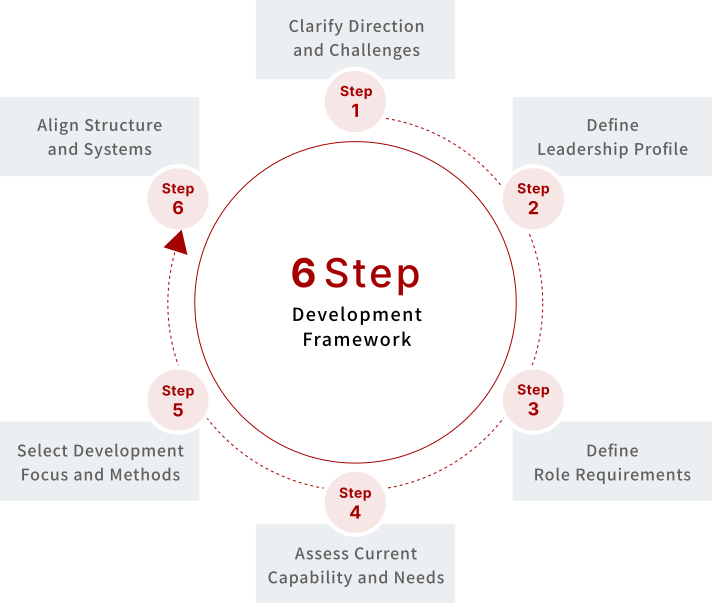
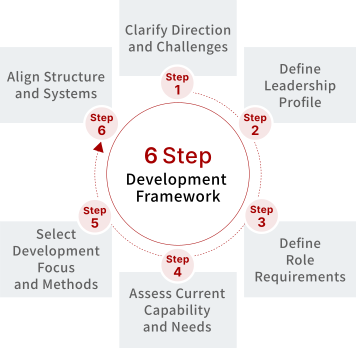
Step 1
Clarify Direction and
Challenges
Step 2
Define Leadership Profile
Step 3
Define Role Requirements
Step 4
Assess Current Capability
and Needs
Step 5
Select Development Focus
and Methods
Step 6
Align Structure
and Systems
Frequently Asked Questions
-
Q.
Does a development framework need to connect to management strategy?
-
A.
A development framework can be built without a direct link to management strategy. Without that link, the leader profile and talent requirements can become unclear, making development themes more likely to shift based on immediate needs.
-
Q.
How should the impact of a development framework be measured?
-
A.
Impact should be measured against the talent portfolio the organization wants to build. This means clarifying what kind of people should be developed, by when, and to what level. Progress toward that portfolio becomes the basis for measuring value.
-
Q.
How should development be designed when HR does not control assignments or placement?
-
A.
When assignments and placement are handled by business units, HR-led development can be difficult to manage alone. A practical starting point is to clarify each participant’s development needs and propose experience opportunities that support growth.
-
Q.
What kind of support does Lead Create provide?
-
A.
Lead Create supports development framework design and the training programs within that framework. The purpose is to help organizations build a system for developing future executive leaders and managers.
-
Q.
How much time does it take to build a development framework?
-
A.
Building a development framework takes three to six months. The process includes defining the talent profile, designing requirements and levels, and creating the overall framework. Once the talent profile is clear, the later stages move more smoothly.
